
When a new referral comes in, the first call I make is to the adjuster. That call tells me what she needs from me, and everything she knows so far.
This file came to me as a potential catastrophic claim.
A 21-year-old worker. A car accident on the job. He was in the hospital with a possible brain injury, and surgery was coming.
That was everything the adjuster knew. She had it from the employer, and the employer had it from whoever was there that day. By the time a story like this reaches a claims desk, it has passed through several hands. Each person passes along what seems important to them, and the details that matter most to a nurse don’t always look important to anyone else.
When I hear “catastrophic,” I think of a traumatic brain injury. An amputation. A degloving injury. Severe burns. Fractures in more than one part of the body. A long hospital stay, then most likely inpatient rehab, and maybe home care after that. A long recovery, for the worker and for everyone around him.
So, before I ever left for the hospital, I started clearing my calendar.
A catastrophic file takes priority, for as long as it needs to. It’s all hands on deck.
I’m at the hospital every day, because things can change in an instant, and one change can shift the whole course of treatment and the outcome with it. Every visit, I meet with the hospital team. I sit down with the worker and the family. And I go through the medical records: the labs, the scans, the consults. All of it.
That’s how I see what’s coming down the road and get ready for it before it gets there.
The insurer needs that information quickly, so they can plan for what’s ahead. The treating team needs authorizations quickly, because care can’t wait on paperwork. I keep both moving.
Then there’s what comes after the hospital. A safe discharge doesn’t happen on its own. Medications have to be understood. Follow-up appointments have to be set. Equipment has to be waiting at home before the worker gets there, not a week later. Every one of those pieces has to be in place on the day he leaves, and someone has to make sure they are.
And there are people on the other side of that hospital door.
A family trying to make sense of the machines and the medical words. Hospitals can be frightening places. The family is asking questions they may be afraid to say out loud. How will we take care of him? How will we pay for this? The last thing a family should have to carry is that worry on top of everything else.
An employer, too. Employers carry more than people realize. Worry. Sometimes even guilt that was never theirs to carry.
I’m the go-between. I take what the hospital team knows to the people who need to understand it, in words they can hold onto. I bring calm to the chaos. On a catastrophic file, it really is a team approach, and the family is part of that team.
That’s what I was getting ready for. A 21-year-old. A long road. A family who would need us.
I didn’t know what I was walking into.
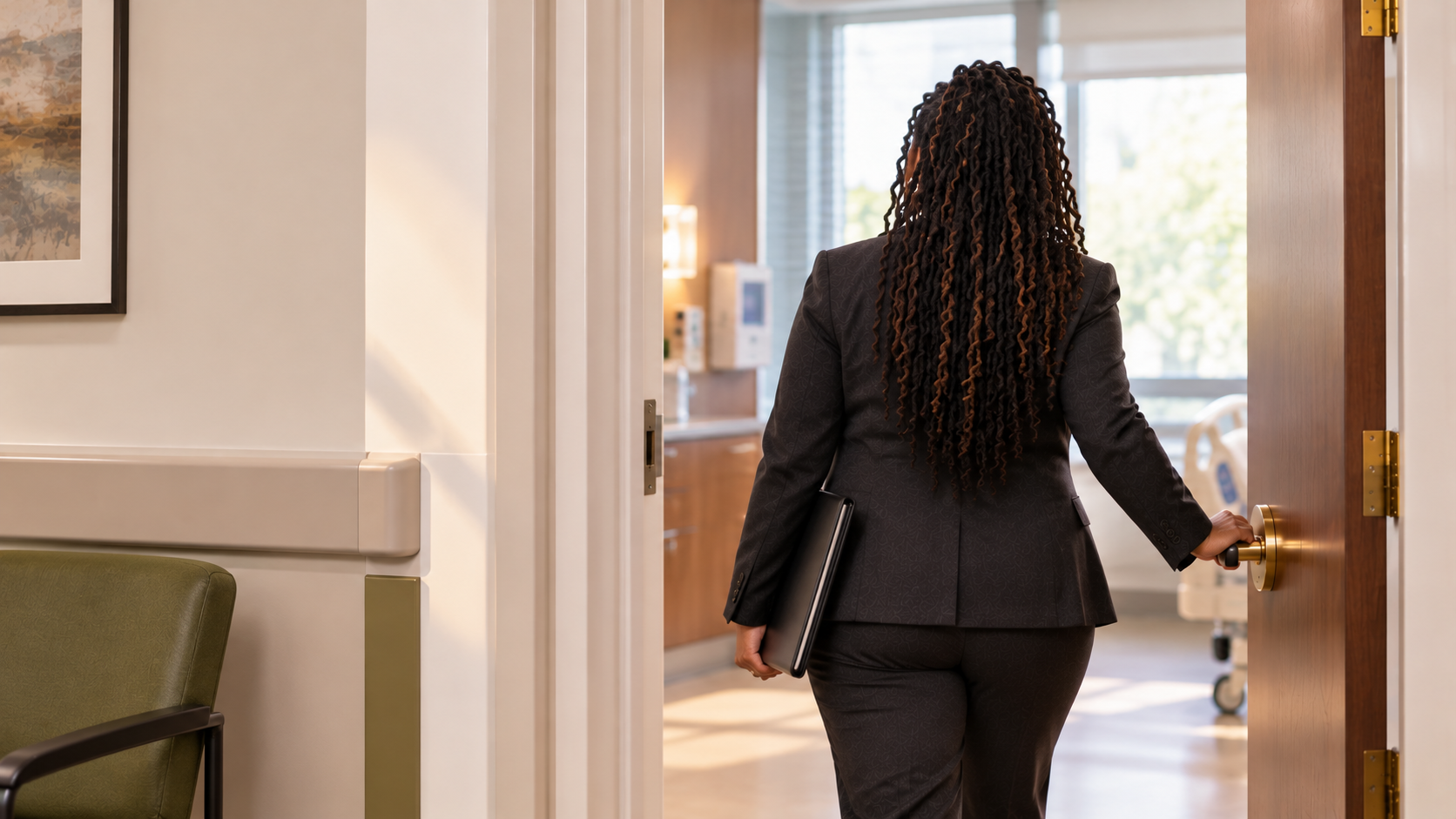
Kimyette Saunders-Bouie, seen from behind, steps through a partly open hospital room door with a file in hand.
At the hospital, I met with his case manager and his nurse. Their overview was short.
He was seriously ill. But it wasn’t the kind of serious I had cleared my calendar for.
I read his medical records. Every page. I always do.
Medical records tell a story. Sometimes they tell the story a person can’t put into words.
His labs showed waste building up in his blood, waste his body should have been clearing on its own. When that happens, a person feels exhausted. Foggy. Sick to their stomach.
His red blood cell count was low too. His body wasn’t getting the signal to make more, so less oxygen was reaching everywhere it needed to go. That leaves you drained. Lightheaded. It can make you faint.
His kidneys were failing.
Then I met him.
He looked okay. Tired. There were dark circles around his eyes. He had just finished a round of dialysis, and that would be his new normal while waiting for a new kidney.
He told me he wasn’t in any pain. He hadn’t hit his head. He was up and walking around.
The file said catastrophic. He was up and walking.
Then the rest of the accident came out. He had been parking a car. He was going about five miles an hour. He had passed out at the wheel.
Then he told me something, almost in passing. He’d been tired. Exhausted, really. Sleepy all the time. He just shrugged it off.
I had already read it in his labs.
He had questions. He wanted to know what kidney failure was, and what his treatment would be.
I explained the basics of what kidney failure is, in plain words.
The rest, I told him, needed to come from his doctor. What stage his kidney failure was in. What treatment his doctor had planned. Those answers were his doctor’s to give.
So, I told him I would get his nurse, so she could take his questions to his physician. I went and got her.
She came into the room and explained more of what his treatment would involve. Then she told him his doctor would be making rounds at 9 a.m.
There was still a question the adjuster would need answered: did the treating team find any injuries from the accident?
A car accident is still a car accident, even at five miles an hour. So, I read his scan reports and the treating team’s notes, the same way I read every page of every file. The team’s findings were clear. No injuries from the accident.
Here is what I don’t do. I don’t decide whether a condition belongs to a workers’ comp claim. I don’t decide what caused it. Those aren’t a nurse’s decisions to make, and they never will be.
What I do is make sure the medical facts reach the people whose decision it is.
Sometimes that means reading every page when the overview seems like enough.
Sometimes it means asking a treating doctor, early, how a new treatment relates to the claim. The answer is his to give, and when it comes early, everyone can plan around it.
Sometimes it means keeping work status tied to the body part each doctor is treating, so a worker isn’t held out of work for a condition no one on the claim is treating.
None of that is dramatic. Most of it happens in the medical records, in conversations with the treating team, and in clear reports to the adjuster. But it’s the difference between a file that moves and a file that stalls for reasons no one can see.
And sometimes, all of it comes down to one phone call.
I called the adjuster and gave her what the treating team had documented: kidney failure, and no injuries from the accident. With the medical facts in hand, she made her decision, and the claim closed.
She closed the claim.
He still needed every bit of the care in front of him. The dialysis. The wait for a kidney. None of that changed. What changed was that his care was headed to the right payor from the start.
Caught months later, it most likely would have been a different story. Workers’ comp would have kept paying for care that belonged somewhere else, then had to reconcile it with his regular insurance to sort out who owed what. Months of bills going to the wrong place. Months of untangling them.
Instead, the file closed cleanly. The insurer had its answer. The employer had its answer.
And when I left that hospital, he knew why he had been so tired.
So, I’ll leave you with this: What would your most serious file look like if someone had been in the room on the first day?
To bring SAUBOU Consulting’s nurse case managers onto your workers’ compensation cases, contact us through our website or connect with me on LinkedIn.
Kimyette Saunders-Bouie, RN, CCM, is the founder of SAUBOU Consulting.
